Editor's brief
Soneva Jani blends overwater opulence with a strict commitment to sustainability. Through its barefoot philosophy, circular economy practices, and biophilic architecture, the resort replaces traditional five-star stiffness with a regenerative approach to luxury that prioritizes mental recalibration and environmental stewardship.
#Sustainable luxury
#Maldives
#Biophilic design
#Regenerative travel
The view from a Trans Maldivian Airways seaplane is the only way to truly grasp the fragmented geometry of the Maldives. From several thousand feet, the Noonu Atoll reveals itself as a series of vivid, turquoise rings dropped onto a deep indigo canvas. As the engine's roar fades and the aircraft touches down on the glassy lagoon, the chaos of the international terminal in Malé dissolves, replaced by a sense of spatial disorientation where the horizon blends seamlessly into the sea. This is the gateway to Soneva Jani, a destination that attempts to reconcile the inherent contradictions of sustainable luxury and overwater opulence. The Ritual of Arrival Stepping onto the jetty, the arrival experience challenges traditional notions of high-end hospitality. Rather than the choreographed sequence of stiff uniforms and scripted welcomes, Soneva Jani employs a psychological reset. The "No News, No Shoes" philosophy is a physical directive; removing footwear strips away societal layers of formality and grounds the guest in the tactile environment, prioritizing organic comfort over ostentatious display. This experience is guided by a personal butler, known as Mr. or Ms. Friday. The service model is intuitive rather than reactive, operating on a principle of anticipation. It is the difference between being asked if you would like more water and finding a chilled glass of infused coconut water already waiting for you the moment you return to your villa. This attentiveness creates a prot...
The view from a Trans Maldivian Airways seaplane is the only way to truly grasp the fragmented geometry of the Maldives. From several thousand feet, the Noonu Atoll reveals itself as a series of vivid, turquoise rings dropped onto a deep indigo canvas. As the engine's roar fades and the aircraft touches down on the glassy lagoon, the chaos of the international terminal in Malé dissolves, replaced by a sense of spatial disorientation where the horizon blends seamlessly into the sea. This is the gateway to Soneva Jani, a destination that attempts to reconcile the inherent contradictions of sustainable luxury and overwater opulence.
The Ritual of Arrival
Stepping onto the jetty, the arrival experience challenges traditional notions of high-end hospitality. Rather than the choreographed sequence of stiff uniforms and scripted welcomes, Soneva Jani employs a psychological reset. The "No News, No Shoes" philosophy is a physical directive; removing footwear strips away societal layers of formality and grounds the guest in the tactile environment, prioritizing organic comfort over ostentatious display.

This experience is guided by a personal butler, known as Mr. or Ms. Friday. The service model is intuitive rather than reactive, operating on a principle of anticipation. It is the difference between being asked if you would like more water and finding a chilled glass of infused coconut water already waiting for you the moment you return to your villa. This attentiveness creates a protective bubble, allowing for a total surrender to the surroundings.
Architectural Opulence and Biophilic Design
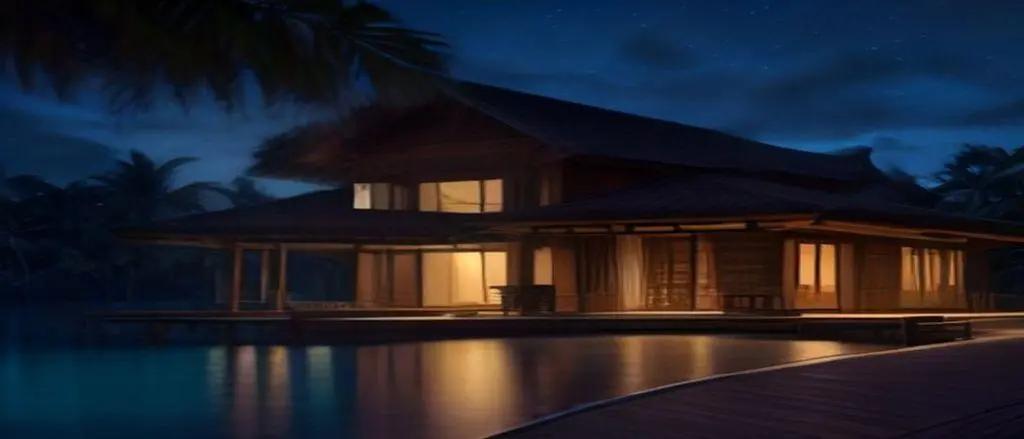
The villas at Soneva Jani are less like hotel suites and more like floating wooden mansions. Their sprawling layouts provide a sense of movement and discovery, separating cavernous living areas from secluded sleeping quarters to mimic a private residence. The architecture utilizes sustainable woods, bamboo, and thatch to ensure the structures complement rather than dominate the turquoise lagoon.
Floor-to-ceiling glass walls render the boundary between the interior and the marine world nearly invisible, keeping guests tethered to the rhythmic movement of the tide. One of the most striking engineering features is the retractable roof above the master bedroom; with a flick of a switch, the ceiling glides open, transforming the room into an open-air observatory for sleeping under the stars.

To balance this sophistication, the villas include private water slides that wind from the upper deck directly into the lagoon. This juxtaposition of high luxury and childlike play encourages a shift in temperament, moving the guest from poised admiration to uninhibited joy. Despite this openness, the strategic positioning of the villas ensures absolute seclusion, granting the freedom to be exposed to nature while remaining hidden from the world.
Gastronomy and the Slow Life
The culinary approach at Soneva Jani rejects the convenience of air-freighted imports in favor of an organic gardening system. In a region where saline soil typically resists agriculture, the resort’s nutrient-rich gardens serve as the heartbeat of the kitchens. This hyper-local sourcing ensures that produce retains a vibrancy and mineral profile often lost in the long-haul logistics required by other Indian Ocean resorts.
The philosophy balances indulgence with functional nutrition, emphasizing raw, fermented, and cold-pressed ingredients. This ensures a dining experience that leaves the guest feeling energized rather than lethargic. Dining under a canopy of stars with the lap of the ocean beneath the floorboards heightens the senses, as the absence of urban noise acts as a natural palate cleanser.

The kitchen operates with a fluidity that allows it to pivot between the precision of Japanese omakase and the rustic warmth of Mediterranean flavors, tailoring compositions to the guest's real-time cravings. This is complemented by a beverage program focused on biodynamic and organic wines, aligning the cellar with the ecological principles found in the gardens.
The Circular Economy of Paradise
While many resorts hide their operational machinery, Soneva Jani invites guests into the Eco Centro. This waste-to-wealth hub functions as a laboratory where discarded glass bottles are blown into art and organic waste is transformed into soil, shifting the guest's role from a passive consumer to a witness of a circular economy in action.
This commitment is embedded in the resort's skeleton. By utilizing Forest Stewardship Council certified hardwoods and avoiding concrete-heavy aesthetics, the resort reduces its carbon footprint in a fragile environment. The elimination of single-use plastics is handled seamlessly; the resort operates its own bottling plants, removing the friction between environmental stewardship and indulgence.

Beyond the land, the philosophy extends to the lagoon through active coral propagation. Guests can work with marine biologists to plant coral fragments, a necessary response to rising sea temperatures that threaten the Maldives' existence [1]. This provides a sobering counterpoint to the opulence of the villas, reminding visitors that the beauty they enjoy is precariously balanced.
Curated Leisure and Wellness
The Noonu Atoll offers a rare depth of night sky, which the resident observatory leverages. Led by professional astronomers, these sessions use high-grade telescopes to map the cosmos, grounding the guest in the sheer scale of the universe. During the day, leisure shifts to Cinema Paradiso, an outdoor theater suspended over the water that evokes the golden age of cinema through the scent of salt air and the glow of lanterns.

On the water, kayaking and guided snorkeling function as field studies in marine biology, highlighting the symbiotic relationships within the house reefs. This intellectual engagement is mirrored in the overwater spa, where treatments synthesize ancient Ayurvedic principles with modern biohacking techniques to optimize recovery and sleep.
The itinerary remains fluid, orchestrated by the "Friday" system. Rather than a rigid menu of activities, the experience is adjusted in real-time based on the guest's interests—whether a specific marine species or a film genre—prioritizing internal rhythm over a corporate schedule.
Conclusion
Soneva Jani redefines exclusivity by suggesting that the ultimate extravagance is not the possession of luxury goods, but the luxury of time, space, and a clear conscience. By stripping away the noise of global connectivity and the stiffness of traditional five-star service, the resort provides a sanctuary for genuine recalibration. While the price point is steep, the value lies in the architectural privacy and the integrity of sustainability efforts that move beyond "green-washing" into regenerative practice.

For the traveler seeking a retreat, the practical takeaway is to embrace the "slow life" fully. The true value of Soneva Jani is realized not by ticking off a list of amenities, but by surrendering to the barefoot ritual and allowing the intuitive service to dictate the pace of the stay. It is an experience that lingers long after the shoes are put back on and the real world resumes.
References
- Intergovernmental Panel on Climate Change (IPCC), "Special Report on the Ocean and Cryosphere in a Changing Climate," 2019.

I'm Isabella De Luca from Italy. After 7 years working across topics related to travel and food storyteller showcasing immersive journeys, local cuisines, and cultural rituals around the world., I’ve discovered that the best writing comes from empathy, clarity, and a genuine desire to connect.