Editor's brief
Black holes are gravitational anomalies where spacetime curves so sharply that light cannot escape. From the stretching effect of spaghettification to the time-bending nature of the event horizon, these objects reveal the fundamental conflicts between general relativity and quantum mechanics at the singularity.
#Black Holes
#Astrophysics
#Spacetime
#General Relativity
A black hole is a region of spacetime where gravity is so intense that nothing—including light—possesses the escape velocity required to leave its boundary [1]. This phenomenon occurs when a significant mass is compressed into an exceptionally small volume, creating a gravitational field that fundamentally alters the geometry of the surrounding universe [1]. Understanding these objects requires a clear distinction between the black hole's physical center and its outer boundary, the event horizon. Defining the Black Hole and the Event Horizon The event horizon is the mathematical and physical threshold surrounding a black hole [2]. Rather than a solid surface, it is a boundary in space. Once an object or photon crosses this limit, the escape velocity required to exit exceeds the speed of light (c), the universal speed limit [2]. Consequently, the event horizon functions as a point of no return for all matter and information. For a non-rotating black hole, the size of this boundary is defined by the Schwarzschild Radius, which is determined solely by the object's mass [1]. A more massive black hole necessarily possesses a larger event horizon. Distinguishing this boundary from the singularity at the center is essential: the event horizon is the threshold of no return, whereas the singularity is the point of total gravitational collapse [2]. This distinction allows physicists to analyze the effects of a black hole on its environment without requiring a complete theory of the sin...
A black hole is a region of spacetime where gravity is so intense that nothing—including light—possesses the escape velocity required to leave its boundary [1]. This phenomenon occurs when a significant mass is compressed into an exceptionally small volume, creating a gravitational field that fundamentally alters the geometry of the surrounding universe [1]. Understanding these objects requires a clear distinction between the black hole's physical center and its outer boundary, the event horizon.
Defining the Black Hole and the Event Horizon
The event horizon is the mathematical and physical threshold surrounding a black hole [2]. Rather than a solid surface, it is a boundary in space. Once an object or photon crosses this limit, the escape velocity required to exit exceeds the speed of light (c), the universal speed limit [2]. Consequently, the event horizon functions as a point of no return for all matter and information.
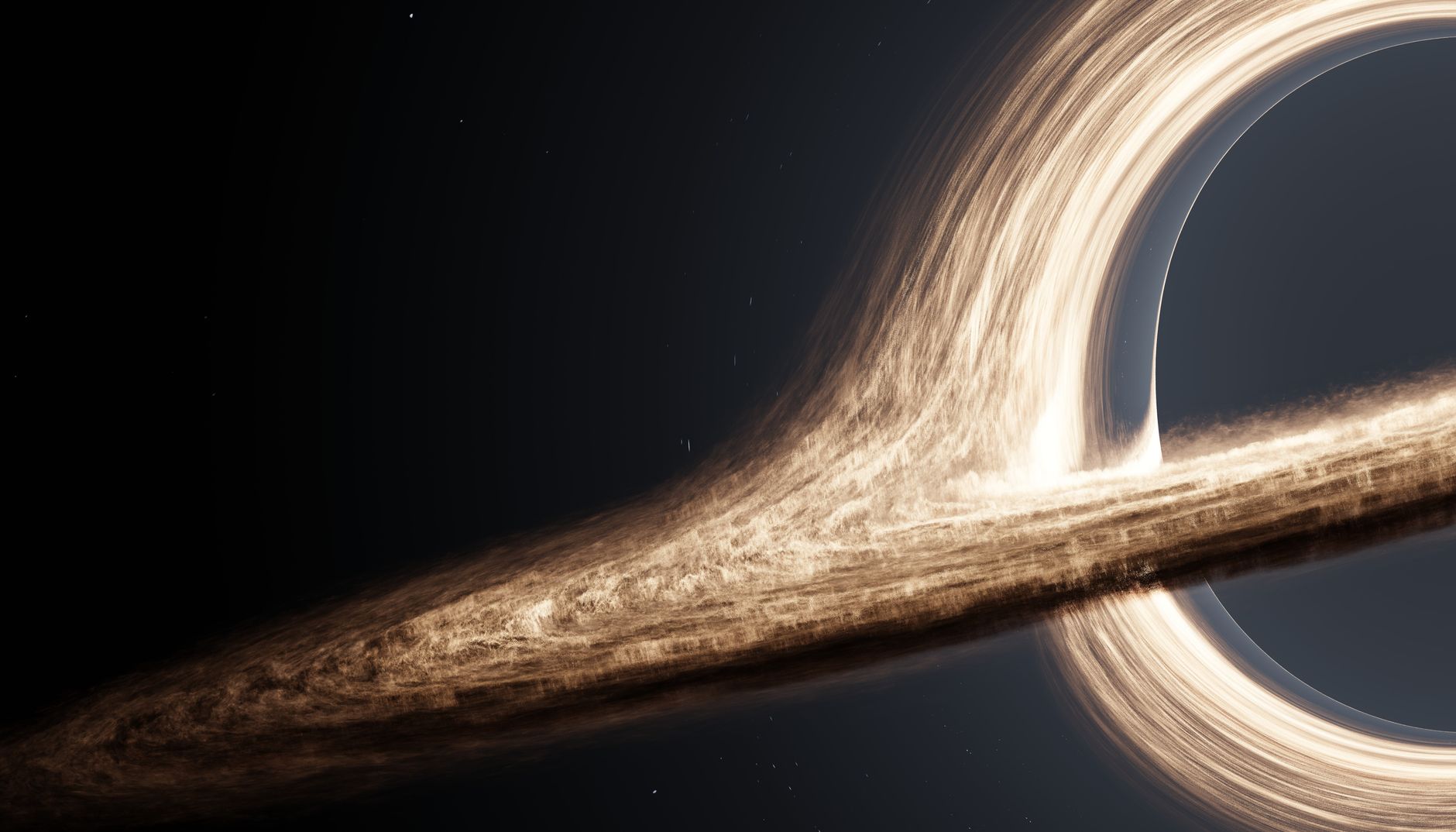
For a non-rotating black hole, the size of this boundary is defined by the Schwarzschild Radius, which is determined solely by the object's mass [1]. A more massive black hole necessarily possesses a larger event horizon. Distinguishing this boundary from the singularity at the center is essential: the event horizon is the threshold of no return, whereas the singularity is the point of total gravitational collapse [2]. This distinction allows physicists to analyze the effects of a black hole on its environment without requiring a complete theory of the singularity's internal physics.
The Mechanism of Space-Time Warping
The influence of a black hole is described by Albert Einstein's General Theory of Relativity, which posits that gravity is not a force acting across a distance, but a result of the curvature of four-dimensional spacetime caused by mass and energy [7]. A common conceptual tool for visualizing this is the "rubber sheet" analogy: a heavy mass creates a depression in a stretched fabric, causing nearby objects to roll toward it not due to a tether, but because the path itself is curved [3]. A black hole creates an extreme "gravity well," warping the fabric of the universe to a critical degree.
This curvature manifests as extreme tidal forces, a process known as spaghettification [3]. As an object falls toward the singularity, the gravitational pull on the leading edge is significantly stronger than on the trailing edge. This gradient stretches the object vertically and compresses it horizontally, drawing it into a thin strand. This warping also affects light through gravitational lensing, where the black hole bends the path of light rays passing nearby [4]. Because of this, black holes act as cosmic magnifying glasses, distorting the images of distant stars and revealing regions of the universe that would otherwise be obscured.
Gravitational Time Dilation: The Warping of Time
General Relativity dictates that gravity affects time as well as space. Gravitational time dilation occurs because time passes more slowly in stronger gravitational fields relative to an observer in a weaker field [5]. This creates a profound discrepancy in perception between a distant observer and an object entering a black hole.

To an external observer, an object descending toward the event horizon appears to decelerate [1]. As the object nears the boundary, the light it emits must fight an increasingly powerful gravitational pull, losing energy and shifting toward the red end of the spectrum—a process called gravitational redshift [1]. Eventually, the object appears to "freeze" at the edge of the event horizon, fading and reddening until it vanishes from sight, never appearing to actually cross the threshold.
Conversely, from the perspective of the falling object, the crossing of the event horizon occurs in a finite amount of proper time, with no local indication of the boundary itself [1]. This paradox demonstrates that time is not a universal constant, but a local property dependent on the observer's position within a gravitational well.
The Singularity and the Breakdown of Physics
At the center of a black hole lies the singularity, a point where the object's entire mass is concentrated into zero volume [6]. According to current models, this results in infinite density and infinite spacetime curvature, creating a regime where the known laws of physics cease to function [7].
This breakdown stems from a conflict between General Relativity and Quantum Mechanics [7]. General Relativity describes the macro-scale curvature of space, while Quantum Mechanics governs the micro-scale behavior of subatomic particles. At the singularity, a massive amount of matter is compressed to a subatomic scale, requiring both theories to be applicable. However, the equations of General Relativity produce "infinities" at this point, suggesting that the mathematical model is an effective theory—accurate at large scales but incomplete at the Planck scale [7]. Resolving this requires a framework of Quantum Gravity to unify the two theories and provide a physical description of the singularity.
Boundary Distinctions: Photon Sphere and Ergosphere
Beyond the event horizon, other distinct regions exist. The photon sphere is located just outside the event horizon, where gravity is so intense that photons are forced into circular orbits [8]. In theory, an observer positioned within the photon sphere could see the back of their own head as light travels a complete circuit around the black hole [8].
Rotating black holes, or Kerr black holes, possess an additional region called the ergosphere [1]. Due to frame-dragging, the rotating mass of the black hole drags the fabric of spacetime along with it [1]. Unlike the event horizon, the ergosphere is not a point of no return; an object can enter and subsequently exit this region. In doing so, it can potentially gain energy via the Penrose process, extracting rotational energy from the black hole [1]. This transforms rotating black holes from passive sinks of matter into dynamic systems capable of transferring energy to their surrounding environment.
References
- NASA, 'Black Holes,' NASA Science, 2024. View source.
- Britannica, 'Event Horizon,' Encyclopedia Britannica, 2024. View source.
- NASA Space Place, 'What Is a Black Hole?' NASA Space Place, 2024. View source.
- Department of Physics, 'Theoretical Physics,' University of Cambridge, 2024. View source.
- Scientific American, 'How Black Holes Warp Time,' Scientific American, 2023. View source.
- Space.com, 'Black Holes: Facts, Formation and How They Work,' Space.com, 2024. View source.
- Stanford Encyclopedia of Philosophy, 'General Relativity,' Stanford University, 2024. View source.
- A. R. Prasanna, 'The Photon Sphere of a Black Hole,' arXiv, 2002, doi: 10.48550/arXiv.gr-qc/0203031. View source.

I'm Viktor Mikhailov from Russia. After 18 years working across topics related to science communicator explaining physics, astronomy, and space exploration in clear, accessible language., I’ve discovered that the best writing comes from empathy, clarity, and a genuine desire to connect.